
Plastic Cap Moulds · 11 min read
Published: September 27, 2026
Tethered Cap Mould vs Standard Cap Mould: A Buyer’s Guide for Beverage Packaging
Tethered closures change more than cap appearance. This guide helps packaging buyers assess hinge function, bottle-neck compatibility, mould scope, trials and production-cell interfaces before placing an order.
SEO information
- **SEO title:** Tethered Cap Mould vs Standard Cap Mould: Buyer’s Guide for Beverage Packaging
- **Meta description:** Compare tethered and standard beverage cap moulds. Learn what buyers should define for cap design, neck compatibility, cavities, IML, trials, automation and acceptance.
- **URL slug:** `tethered-cap-mould-vs-standard-cap-mould`
- **Primary keyword:** tethered cap mould
- **Secondary keywords:** beverage cap mould, plastic cap mould supplier, 38mm tethered cap mould, cap mould selection, closure mould factory test
- **Search intent:** Commercial investigation / solution comparison
Tethered closures are changing the questions packaging buyers ask a mould supplier. The visible difference—a cap that remains attached to the bottle after opening—can appear simple. In practice, it affects cap geometry, hinge performance, neck-finish compatibility, tamper band, ejection concept, automation, inspection and the trials required before shipment.
This guide is for buyers evaluating a new plastic cap mould for water, carbonated beverages, edible oil or other packaging programmes. It explains how tethered cap moulds differ from conventional cap moulds, what information should be included in an RFQ, and how to judge whether a supplier understands the complete closure system rather than only the mould steel.
First, define the project correctly
A mould supplier needs more than “28 mm cap mould” or “38 mm tethered cap mould.” The product must be defined by a controlled cap drawing and the bottle-neck interface. Ideally, the buyer supplies an approved bottle neck drawing, an existing cap sample or 3D data, resin specification, colour plan, expected output and packaging application.
For a beverage closure, identify:
- neck finish, thread, sealing land and transfer-ring details;
- cap outer diameter, height, wall sections, ribs and knurling;
- tamper-evident band design and bridge condition;
- tether/hinge geometry, opening direction and required retained-cap behaviour;
- linerless or liner-based seal concept;
- resin, colour masterbatch and any recycled-content constraints;
- capping torque window, opening torque, leak or carbonation requirement where applicable;
- annual volume, planned cavity count, injection machine and downstream slitting, folding, assembly or vision-inspection equipment.
The regulations and market rules applicable to a closure depend on the destination, product type and packaging system. A mould supplier should not make compliance claims without the buyer's applicable specification. The practical role of the supplier is to manufacture the agreed cap geometry consistently and support a trial plan that verifies the requested functional checks.
What changes when the cap is tethered?
The hinge is a functional feature, not decoration
In a standard screw cap, the mould must create a consistent thread, seal and tamper band. In a tethered closure, the hinge or retaining element adds a repeat-use mechanical requirement. Its thickness distribution, gate location, orientation, moulding stress and cooling can affect how the cap opens and remains attached.
The cap must be assessed in its intended sequence: moulding, possible slitting or folding, capping, opening and closing. A trial sample photographed flat on a table cannot demonstrate all of these conditions. Ask how the supplier will evaluate the tether action and what customer-supplied capping or bottle components are needed for a meaningful test.
Neck compatibility becomes even more important
The closure is designed around a particular neck finish. If the bottle neck, cap thread or tamper band changes, the retained-cap behaviour may also change. Share the controlled neck drawing at the start and identify which version of the cap and neck data controls the purchase order. If the buyer has a separate cap designer, bottle supplier and mould maker, name the responsible technical contact for each interface.
The process chain may be longer
Depending on the closure design, a finished tethered cap may require moulding plus a controlled downstream operation. The quotation should make clear what is inside the mould scope and what is assumed to happen in the customer's cap-production cell. This prevents a common misunderstanding: a mould can produce a cap component correctly, while the final tether function still depends on a separate cutting, folding, assembly or capping operation.
Standard cap moulds still suit many programmes
Conventional cap moulds remain appropriate when the approved packaging design uses a conventional closure and its market requirements do not call for a tethered feature. They can be highly efficient multi-cavity tools when the cap design, hot runner, cooling and automation are correctly matched.
The decision should not be framed as “new versus old.” It is a requirement-fit decision. A standard cap tool may be simpler in geometry and downstream handling; a tethered-cap tool may be necessary when retention after opening is part of the approved packaging design. In either case, buyers should evaluate total operating fit: cap quality, neck match, cycle stability, scrap risk, maintenance, automation and available technical support.
How to select cavity count and hot-runner concept
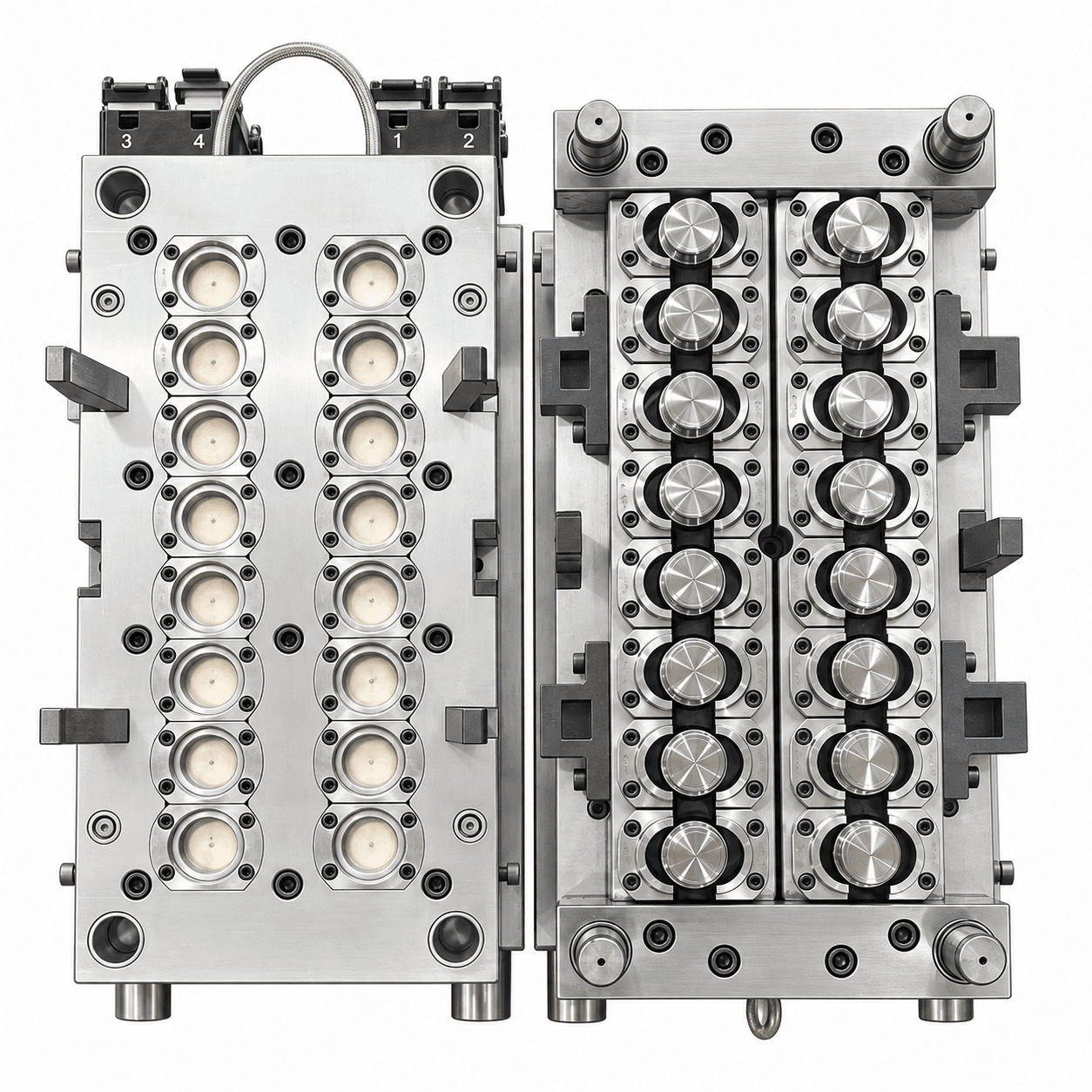
Cap moulds are often specified at high cavity counts because individual caps are light and output requirements can be large. However, a high cavity count makes balance, cooling uniformity, maintenance and machine compatibility more important. The buyer should provide the expected good caps per hour and the available injection-machine data. The supplier should explain the proposed cavity layout, hot-runner system, controller, gating approach, mould envelope, clamp requirement and cooling assumptions.
What a credible cycle-time discussion sounds like
It does not begin with a single number. It identifies cap weight, resin grade, cavity count, machine capability, expected cooling condition, automation and trial basis. A supplier may provide an estimated range for planning, but final acceptance should be connected to agreed test conditions. Thin sections, hinge areas, colour changes and post-mould handling can all influence what is repeatable in an actual production cell.
Cooling and cavity balance
Cooling affects more than cycle time. Uneven cooling can contribute to variation in shrinkage, thread dimensions, hinge performance and cap feel. During factory testing, record reasonable process conditions and compare samples across cavities. For high-cavity moulds, use cavity identifiers or a sampling map so that an issue can be traced to a location instead of being described vaguely as a “quality problem.”
RFQ checklist for a cap mould supplier
Include these inputs in a request for quotation:
- Approved cap 2D/3D data and revision number.
- Bottle-neck drawing and a matching bottle or neck sample where available.
- Resin type, approved masterbatch and whether food-contact documentation is required from the resin supplier.
- Cap weight target and allowed variation under the buyer's quality plan.
- Cavity count, required output and injection-machine specifications.
- Hot-runner/controller preference, electrical standard and spare-parts expectations.
- Details of any slitting, folding, assembly, lining, compression or vision system outside the mould.
- Required sample tests: dimensions, cap fit, torque, leak, opening/closing and tether retention as applicable.
- Factory acceptance, shipment inspection, export packing and commissioning support expectations.
This checklist is intentionally detailed. It makes hidden interfaces visible before the tooling schedule starts.
Factory testing for conventional and tethered caps
Factory testing should be based on the agreed scope, material and moulding conditions. The following checks are commonly worth planning:
- mould identity, cavity count and key component verification;
- dry-cycle function, opening/closing and ejection stability;
- hot-runner heating, temperature control and cavity fill balance;
- cooling-circuit flow, leak check and connector identification;
- a continuous production run long enough to observe stable operation;
- cap weight, appearance, flash, gate condition and thread quality;
- dimensional checks on the controlled features;
- cap fit and torque testing with the matching bottle neck where supplied;
- tamper-band bridge condition and separation behaviour;
- for tethered closures, opening, retention, reclosing and repeat-use observations using the intended bottle/capping context;
- a report containing process conditions, sample identification, issues found and agreed corrective actions.
Do not use an unverified generic torque figure as a universal acceptance limit. The applicable cap, neck, liner/seal arrangement and customer validation plan determine the appropriate checks. The useful question is: “Can this sample demonstrate the approved function under the conditions we will use?”
Shipment inspection and handover documents
Before shipment, confirm that the mould is protected against corrosion, water circuits are drained or handled according to the agreed preservation method, electrical components are protected, lifting points are marked and the mould is restrained inside a suitable crate. Photograph the mould, accessories, spare parts and internal packing before the crate is closed.
The handover pack should include the information that the receiving factory needs for installation preparation: mould outline, water circuit and connector diagrams, controller or hot-runner documentation, trial report, sample inspection record, spare-parts list, maintenance guidance and packing list. If a tethered-cap project includes post-mould equipment supplied by another party, document the interfaces and responsibility boundaries.
Practical sourcing questions that reveal supplier capability
Ask these questions during technical review:
- Which cap and neck drawing revisions are controlling the design?
- What function does the proposed hinge or tether have after the cap is moulded?
- Which aspects will be checked in the mould trial, and which require the customer's capping line?
- How are cavity samples identified and compared?
- What machine and utility conditions were used to derive the estimated output?
- Which consumable and wear parts should be stocked before production launch?
- What evidence will be provided at shipment inspection?
The answers should be specific to your closure. Be cautious when every project receives the same answer, especially for a special tether design or a new bottle neck.
Frequently asked questions
What is a tethered cap mould?
It is an injection mould designed to produce a closure component with a retained-cap feature, such as a hinge or tether. The final retained-cap function can also depend on the approved bottle neck and any post-mould operations in the cap-production cell.
Can a standard cap mould make a tethered cap?
Only if the cap geometry and process route were designed for that purpose. A conventional tool cannot be assumed to create a functional tethered closure by changing the product name. Review the approved cap drawing, neck interface and downstream process with the supplier.
What should be tested before a cap mould is shipped?
Plan for mould movement, hot runner and cooling function, stable cycles, cap appearance and dimensions, cap-to-neck fit and any product-specific checks such as tamper-band behaviour, torque, leak performance or tether retention. Agree the acceptance method in advance.
Do I need to send the bottle neck or cap sample to the mould supplier?
Yes, when possible. A controlled drawing is essential, and physical samples help the supplier prepare a more meaningful factory test and reduce interface assumptions.
Talk to a mould engineer
Need a practical review of a beverage, edible-oil or tethered-cap project? Ask for Product Catalogue and Technical Review. Send the cap drawing, bottle-neck data, target output and injection-machine information; SHUNYOU will identify the mould and production-cell questions to resolve before quotation.
Get a Quote →