
PET Preform Moulds · 10 min read
Published: October 1, 2026
PET Preform Mould Venting and Gate Quality: A Buyer Guide
Define gate condition and venting as measurable, traceable project requirements before a PET preform mould is released for manufacture.
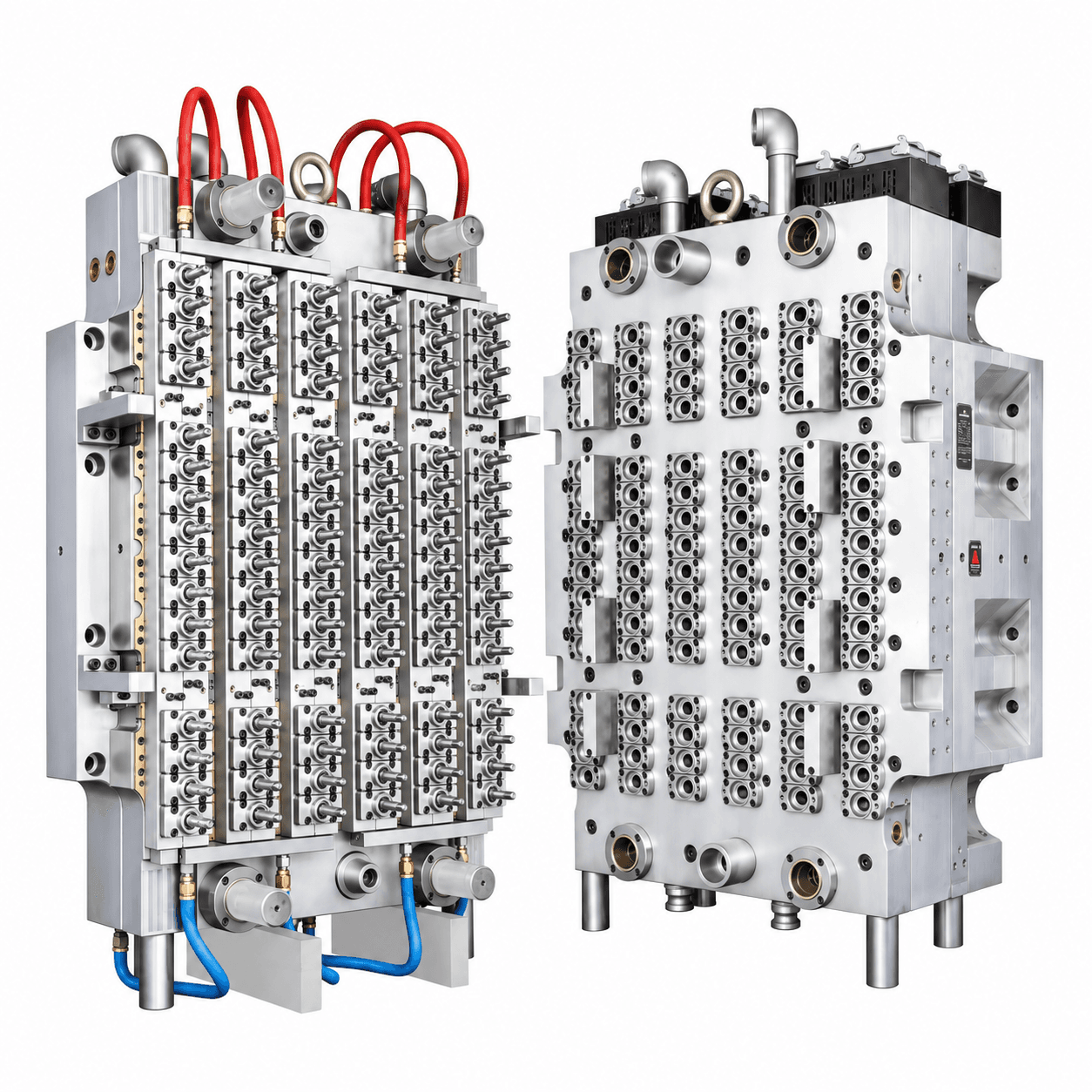
Gate condition and air evacuation are easy to overlook in a PET preform RFQ because they are small details inside a high-output tool. In production, however, they can affect filling consistency, gate appearance, neck-area quality, ejection behaviour and the amount of process adjustment needed to keep output stable. A buyer does not need to prescribe a supplier's tooling method. The buyer does need to define the product revision, resin, acceptance priorities and evidence required at factory trial.
This guide explains how to turn venting and gate quality into practical design-review and factory-acceptance items for multi-cavity PET preform moulds. It avoids treating a single visual sample or a short trial video as proof of long-term production performance.
Why Venting and Gate Quality Belong in the Same Review
During injection, displaced air must have a controlled route out of the cavity while melt reaches the intended fill condition. At the gate, the hot-runner, gate geometry, cooling and process setting influence the final gate area. These subjects interact with, but are not limited to, the manifold. Resin preparation, melt condition, injection profile, clamp behaviour, cooling water, mould alignment and maintenance condition can change the observed result.
For a PET preform, a visual issue near the gate should not automatically be blamed on one component. It may be a process, material, venting, cooling, handling or local-cavity question. Good project control starts by separating observations from assumptions.
Risks buyers should recognise
- Incomplete filling or unstable visual condition may indicate that process conditions and air evacuation need review.
- A gate area that is inconsistent between cavities can complicate downstream inspection and blow-moulding evaluation.
- A mark introduced during removal or sample handling can be mistaken for a mould defect.
- A trial made with undocumented resin or utilities cannot be compared fairly with commissioning at the receiving factory.
Define the Inputs Before Design Release
The most useful requirement is not “no defect.” It is a traceable package of agreed product and trial information. Provide the approved preform drawing, neck-finish reference, target weight, PET grade, intended colour or masterbatch condition where applicable, cavity count and injection-machine information. Identify any critical dimensions or downstream checks that matter to the bottle programme.
| Buyer input | Why it matters |
|---|---|
| Approved preform and neck-finish drawing | Fixes the part revision and inspection reference |
| Resin and preparation expectation | Makes factory-trial conditions understandable |
| Cavity count and production objective | Sets the scope for sampling and practical review |
| Machine and controller interface | Helps confirm installation compatibility |
| Gate and appearance priorities | Focuses inspection on the features that affect the project |
Avoid copying a generic gate tolerance or cycle claim from another mould. A credible proposal explains what is inspected, how samples are identified and what conditions apply to the evidence.
Review the Mould Design Without Over-Specifying It
Ask for the right gate information
At design review, ask the supplier to identify the gate concept, relevant hot-runner zones, controller interface, cavity numbering method and planned service access. This is not a request for proprietary drawings in every case. It is a request for enough information to understand the production and maintenance interfaces after delivery.
For a high-cavity tool, confirm how the project will keep cavity identity connected to sample results. If a concern appears during a trial, cavity traceability allows the team to distinguish a local condition from a broader process response.
Treat venting as a maintainable feature
Venting should be considered together with parting-line condition, insert fit, cleaning access and routine inspection. A vent path that works at first trial but cannot be checked or maintained at the production site creates avoidable uncertainty. Ask what normal cleaning and inspection activity is expected, which areas need attention and how the supplier records any design or trial adjustment.
The answer should remain practical. Buyers should not demand a universal vent dimension for every part; geometry, resin, surface requirements and process window determine the appropriate detail.
Build a Factory Trial That Produces Useful Evidence
Agree the FAT plan before the trial. It should identify the machine used, material supplied for the trial, relevant process condition, sample sequence, cavity traceability and inspection items. The goal is repeatable evidence, not an unrealistic promise that every receiving plant will run at the same setting.
Check a stable run, not only start-up parts
Samples taken during start-up, adjustment or a diagnostic short-shot study should be labelled as such. For the agreed stable run, record the observed cycle time, material condition available for the trial, relevant controller setting information, cooling connection condition and visual observations. If an issue is seen, note the corrective action or limitation rather than hiding it in a selection of attractive samples.
Inspect across the cavity layout
The sampling quantity depends on project risk and agreement, but sampling should cover the mould layout rather than only one convenient location. Use the agreed drawing and inspection method for checks such as part weight, gate condition, neck features, appearance and any required functional interface. Where a matching bottle and closure are available, keep that check separate from mould-only observations and document the items used.
Prepare for Shipment and Site Commissioning
Before shipment, verify that water, electrical and controller connections are identified; exposed surfaces are protected; lifting points are clear; and the agreed manuals, spare-part references and trial record are handed over. Shipment photos should show the condition before crating.
At installation, reconnect the documented interfaces, confirm utilities and controller compatibility, and repeat the agreed sampling discipline under the receiving plant's conditions. Site commissioning is not a formality: it is where resin drying, machine response, water supply, handling and operating practice become part of the production result.
Frequently asked questions
Does a good gate appearance at FAT guarantee site performance?
No. It is evidence under the documented factory condition. Resin preparation, machine settings, utilities and operating practice at the receiving site can alter the result. The value of FAT is traceability and a shared technical baseline.
Should every cavity be checked?
The inspection depth should be agreed according to product risk, cavity count and acceptance priorities. Broad cavity coverage and clear cavity identification are especially valuable where downstream bottle performance is sensitive.
Is venting only a supplier responsibility?
The supplier owns the tooling solution, but the buyer should supply correct product, resin and acceptance inputs and maintain the agreed inspection and cleaning discipline after delivery. Production stability is a shared interface between tool, machine, material and process.
Talk to a mould engineer
Request a PET preform gate-and-venting review: Send your preform drawing, resin, neck-finish data, cavity target and injection-machine details for a practical configuration review.
Get a Quote →